From Survival to Strategy: How AI Can Turn Skills Into Income
AI is becoming an equalizer — compressing years of training, education, and access into tools anyone can use to learn high-income skills and earn online.
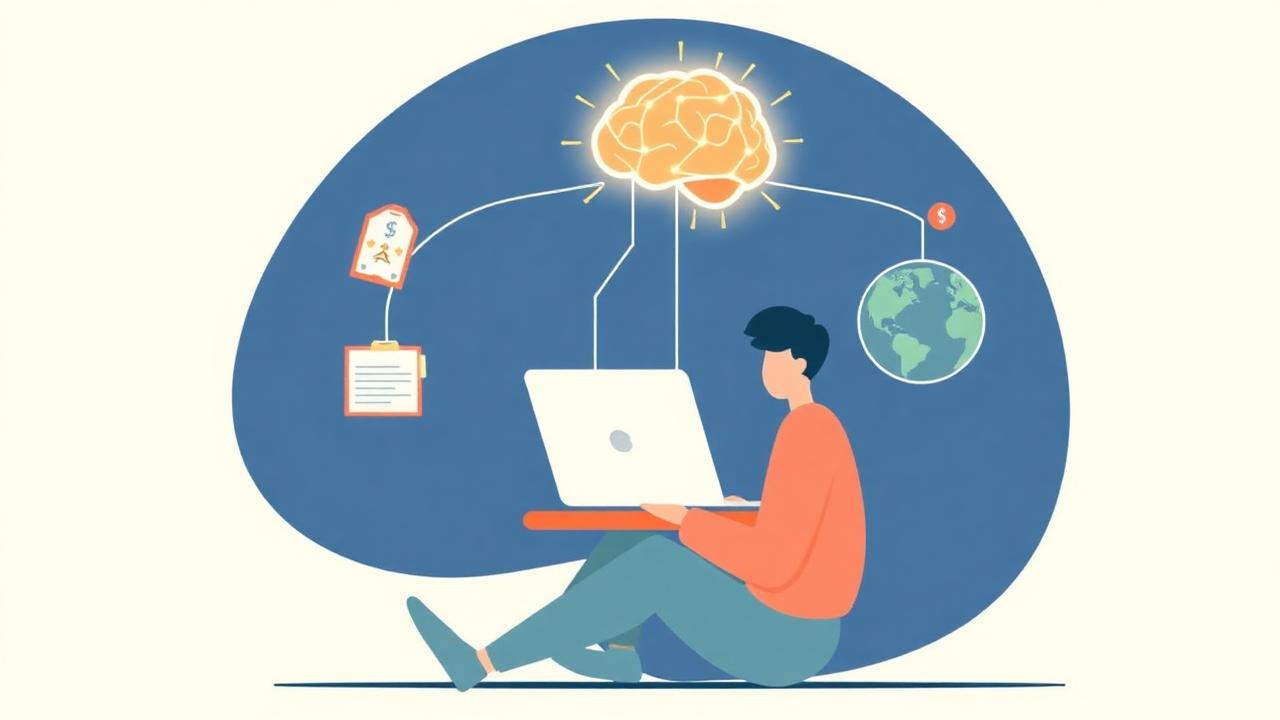
For generations, escaping financial hardship has often depended on access — access to education, capital, networks, and opportunity. The problem is simple: many people never get equal access. Artificial intelligence is starting to change that equation in a meaningful way. It is not just a tool; for those who use it deliberately, it can act as an equalizer.
The old model vs. the new reality
Traditionally, if you wanted to earn more, you usually needed years of formal education, expensive training, and connections in the right places. Today, AI compresses parts of all three.
With AI assistants, content generators, and automation tools, a person with little formal training can:
- Draft professional-level written content in a fraction of the time.
- Pressure-test small business ideas and pricing.
- Learn high-income skills faster through tailored explanations and feedback.
- Offer services to clients anywhere in the world from a laptop.
This is not theory — it is already how a growing share of online freelancers and small operators work day to day.
AI as a skill multiplier, not a replacement for effort
The most important shift AI introduces is this: it does not remove effort, it multiplies it.
A person earning a modest hourly wage can use AI to:
- Learn the basics of copywriting in weeks instead of years.
- Produce drafts of marketing content for small businesses to refine.
- Offer freelance services on platforms like Fiverr, Upwork, or Contra.
For example, someone with conversational English can use AI to outline and polish blog posts. Someone with a basic eye for design can use AI tools to iterate on logos and brand directions. Someone with no coding background can build simple internal tools or landing pages with AI guidance.
Used this way, AI turns low-experience entry points into services people will actually pay for — provided the work is genuinely useful and reasonably good.
The freelance gateway
One of the most accessible paths to extra income with AI is freelancing. A simple version of the path looks like this:
- Pick one specific service (writing, social-media management, basic design, data entry, customer support, virtual assistance).
- Use AI to improve quality and speed — drafts, outlines, research, proofreading.
- Offer your service online through marketplaces, niche communities, or direct outreach.
- Scale by raising prices and adding repeat clients, not by working more hours.
AI can help you generate proposals, deliver faster, and stay consistent — which lets a beginner compete more credibly with experienced providers. For a more detailed walkthrough of this path, see our guide on starting freelancing with no experience.
Why most people still fail (and how to avoid it)
Access to AI alone does not guarantee any income. Most people who try and stop usually fall into the same patterns:
- They consume AI content and tutorials but never apply them to real work.
- They lean on AI so heavily that the output is generic and easy to replace.
- They focus on tools and prompts instead of monetizable, in-demand skills.
To make AI useful financially, treat it as a tool, not a crutch. Focus on solving real problems for real people, delivering measurable value, and understanding the market you're selling to. AI accelerates execution — but direction still has to come from you.
An illustrative path: from first gig to monthly retainer
Here's a made-up but realistic example of how the steps above can come together. Maria works evening shifts and has basic writing skills. She uses an AI assistant to study how small local businesses write their newsletters, then drafts three sample newsletters for businesses she invents.
- Month 1: She offers "one monthly email newsletter for local shops" on a marketplace and in two local business groups. She lands one $60 job.
- Month 2: She delivers early and asks for a review. She gets a second client from a referral.
- Month 3–4: She packages her work: two newsletters and four social posts a month for $250. One client agrees.
Nothing here is guaranteed, and many people move slower. The pattern is what matters: one narrow offer, proof of work, then packaging. AI saved Maria drafting time. Her own judgment about what each shop's customers care about is what clients paid for.
Skills that keep their value as AI spreads
As more people use the same tools, raw output becomes cheap. What stays valuable is harder to automate:
- Knowing an industry well: restaurants, trades, healthcare offices, immigrant-owned businesses.
- Communication and reliability: answering quickly, meeting deadlines, and explaining your work clearly.
- Editing and quality control: catching AI errors before the client does.
- Languages and culture: bilingual people can serve communities that generic AI output serves poorly.
Be honest with clients about AI
Some clients are fine with AI-assisted work. Others ban it in their contracts, especially for legal, medical, or academic content. Ask up front, follow what's in the contract, and never paste a client's confidential information into a public AI tool without permission. Being open about how you work builds the trust that turns one-off gigs into long-term clients.
A new definition of opportunity
We are entering a period where knowledge is increasingly free, tools are widely accessible, and many traditional barriers are falling. The remaining differentiator is execution.
Someone with discipline, a clear niche, and AI in their toolkit can outperform someone with credentials but no initiative. That is a meaningful change in how opportunity is distributed.
Keep reading
- For a step-by-step plan on landing your first paid client, see how to start freelancing with no experience.
- For income paths beyond freelancing, see how to make passive income with AI in 2026.
- Find more guides on the Making Money hub.
The bottom line
AI does not magically remove financial hardship — but for people willing to apply it, it removes a long list of excuses. Used well, it lets you learn faster, earn sooner, and compete globally. The question is no longer only "do you have access?" — it is also "are you willing to use it?"
Frequently asked questions
Q.Can AI really help me earn more money?
Yes — but indirectly. AI doesn't pay you on its own. It speeds up how fast you learn a marketable skill, how quickly you can deliver work, and how professional your output looks. The earnings still come from finding clients or employers willing to pay for the value you create with that skill.
Q.What are the best AI-assisted skills to start with?
Skills with low barriers to entry and clear deliverables: writing and editing, social-media content, basic graphic design, simple websites and landing pages, customer support, data cleanup, and translation. AI helps you get to a competent baseline faster, but you still need to specialize and find a real audience.
Q.Do I need to pay for premium AI tools to earn online?
Not at first. Free tiers of major AI assistants are usually enough to learn, draft, and ship early client work. Once you have steady paid work, a paid plan often pays for itself in time saved on a single project. Avoid expensive 'AI side-hustle courses' that promise guaranteed income.
Q.Will AI replace the people trying to use it for income?
AI is much more likely to replace tasks than entire jobs. The people most at risk are those who do nothing but the same low-context task that AI can now do in seconds. The people who benefit most are those who use AI to do more, faster, while bringing judgment, taste, and client relationships that AI can't replicate.
Related Articles
How to Use AI to Get Out of Poverty in 2026 (Step-by-Step Guide for Beginners)
A practical, beginner-friendly guide to using AI to learn a marketable skill, start freelancing from zero, and turn one-off gigs into stable income.
12 min read
AI EconomyHow to Make Passive Income With AI in 2026 (Even If You're Broke)
A beginner-friendly guide to building passive income streams with AI in 2026 — blogs, digital products, and content pages you can start with zero budget.
11 min read
AI EconomyHow AI Can Help You Manage Money and Build Wealth (Beginner's Guide)
A beginner-friendly guide to using AI to budget smarter, pay off debt faster, learn investing, and avoid costly money mistakes in 2026.
10 min read
AI EconomyFrom One Paycheck to Many: How AI Is Quietly Building a New Middle Class
Why depending on a single paycheck is the most fragile financial position — and how AI is making it realistic for one person to build several income streams at once.
12 min read